Parker Custom Security replaced the main entrance doors at Mount Horeb Holiness Church of God, 1788 Townsend Avenue in the Bronx, with a pair of fire-rated hollow metal doors and a complete new hardware package.
The original painted steel doors had worn out. The bottom edges had deteriorated enough to let daylight show underneath, only one leaf had a closer, and the second leaf was held by a surface-mounted bolt that someone had to remember to set.
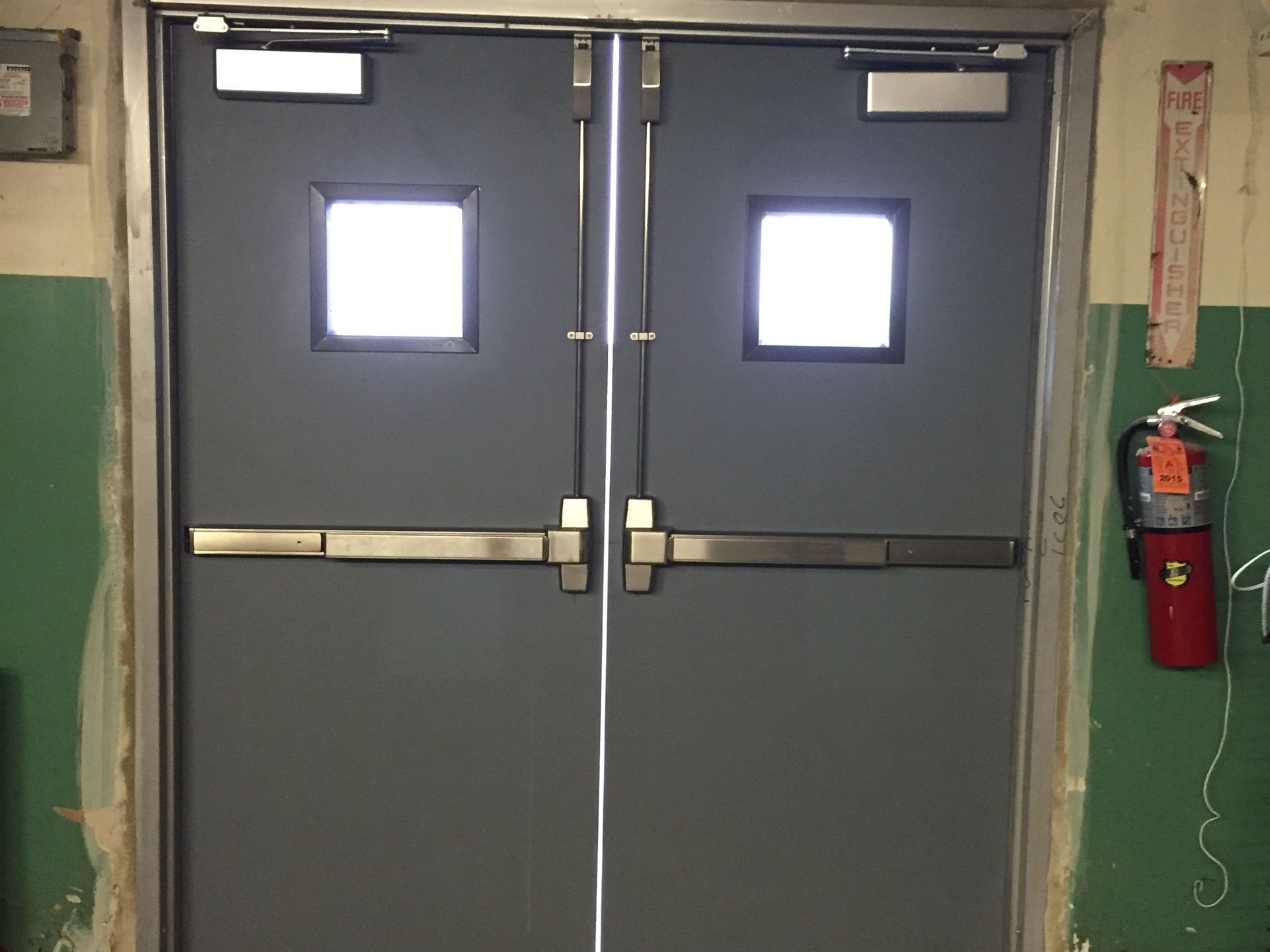
The new opening has a closer on each leaf, a vertical rod exit device on each leaf that latches at the head and the sill, narrow vision lites, and exterior lever trim. The congregation can leave through either leaf in an emergency, and the entrance still closes and latches on its own.
Parker Custom Security has installed fire-rated doors and commercial door hardware for churches, schools, and apartment buildings across New York City since 2003.
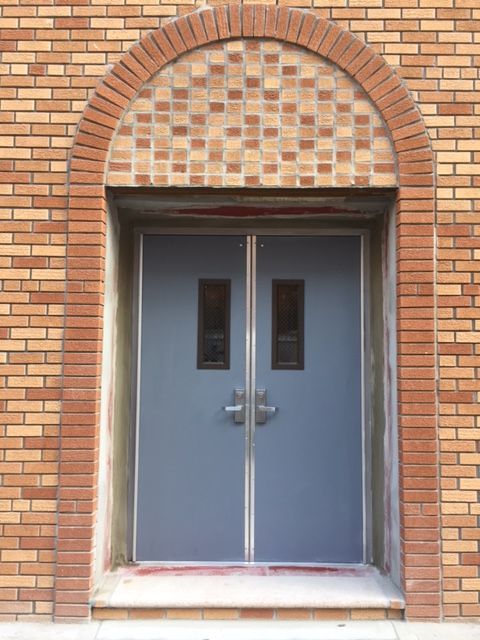
The finished entrance at Mount Horeb Church on Townsend Avenue: new fire-rated hollow metal doors set in the original arched brick opening.
Replacing the Main Entrance Doors at Mount Horeb Church in the Bronx
A church entrance works harder than most doors in the city. On a Sunday it has to welcome a steady stream of people and let a full sanctuary out quickly. Midweek it has to stay secure while the building is mostly empty. It needs to do both for decades, usually on a small maintenance budget.
Mount Horeb Holiness Church of God sits on Townsend Avenue in the 10453 area of the Bronx, between Mount Hope and Morris Heights. The main entrance is a pair of doors set into an arched brick opening, and it serves as the congregation's primary way in and out of the building.
The church called Parker Custom Security because the existing doors and hardware had reached the end of their service life. The goal was a door that closes, locks, and releases the way it should, every time, and that makes the church harder to break into without making it harder to leave.
Project Details
The Challenge: Aging Church Doors That No Longer Secured the Building
The original doors were a painted steel pair with cross-shaped glass lites, a familiar detail on church entrances across the Bronx. Years of heavy use had worn them down in the ways that matter most for security and safety:
- Deteriorated bottom edges: daylight was visible beneath the doors from inside, which lets in weather and shows that the doors no longer sat true in the frame.
- One closer for two doors: only one leaf closed on its own. The other depended on whoever used it last.
- A manual bolt on the second leaf: the inactive door was held by a surface-mounted bolt. If nobody set it, the pair was not really secured.
- Worn lock hardware and finish: the center lockset and the paint on both faces had seen decades of daily hands.
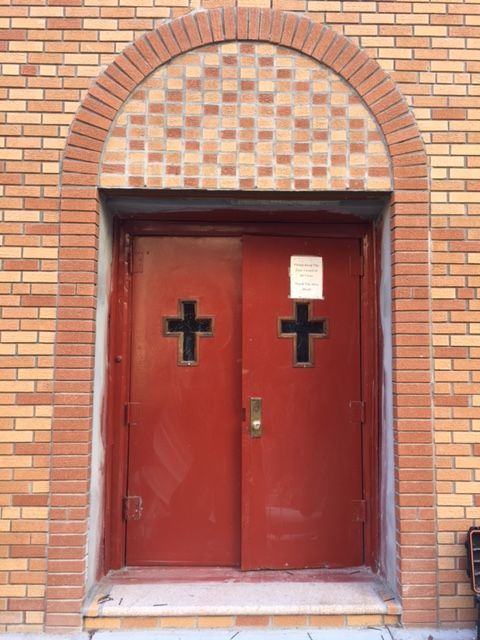
Before: the original painted steel pair with cross-shaped lites and a single center lockset.
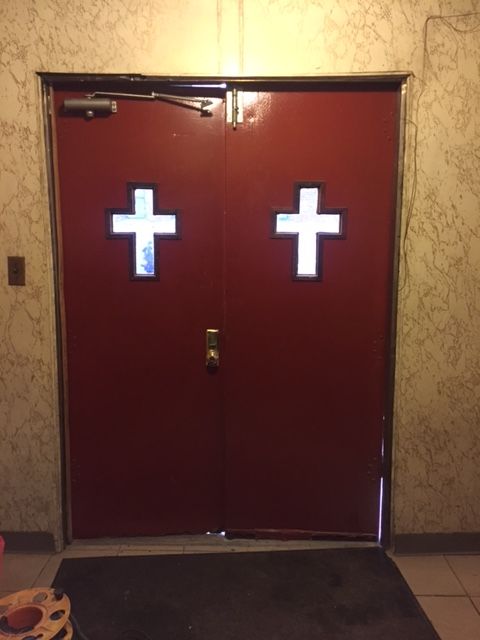
Before, from inside: one closer on one leaf, a surface bolt at the head, and light showing along the bottom.
Door Security Problems We See at Houses of Worship and Public Buildings
Churches, mosques, synagogues, community centers, and other public buildings share a set of door problems. If you manage one of these buildings, some of these will be familiar:
- "We chain the doors at night." Chains and padlocks on an exit door are a fire-code violation, and they are a real danger if someone is still inside. The right exit hardware makes them unnecessary.
- "Somebody forgot to lock the second door." Any pair that depends on a person throwing a bolt will eventually be left unlocked.
- "The door doesn't close all the way by itself." A worn or missing closer leaves the building open after every visitor and defeats the lock.
- "We keep repairing the same door." When the door itself has deteriorated, new hardware on an old leaf will not last.
- "We want to be welcoming, not a fortress." Good hardware is how you get both. People can leave freely and entry stays controlled.
Nearly all of these come back to the door and hardware as one system. Replacing the door, closers, and exit devices together fixes the whole list at once.
The Solution: Fire-Rated Hollow Metal Doors with Vertical Rod Exit Devices
Instead of patching the old doors, Parker replaced the pair and its hardware as a complete assembly. That means a new fire-rated hollow metal door on each leaf, with hardware chosen so that both leaves close, latch, and release on their own.
- Removal and disposal of the old steel doors and all existing hardware
- Two new fire-rated hollow metal doors, fitted to the existing arched masonry opening
- Narrow vertical vision lites in each leaf, so ushers and staff can see who is at the door
- A surface vertical rod exit device (panic bar) on each leaf, latching at the head and the sill
- A commercial door closer on each leaf, so both doors return and latch without help
- Exterior lever trim on both leaves for controlled entry from the street
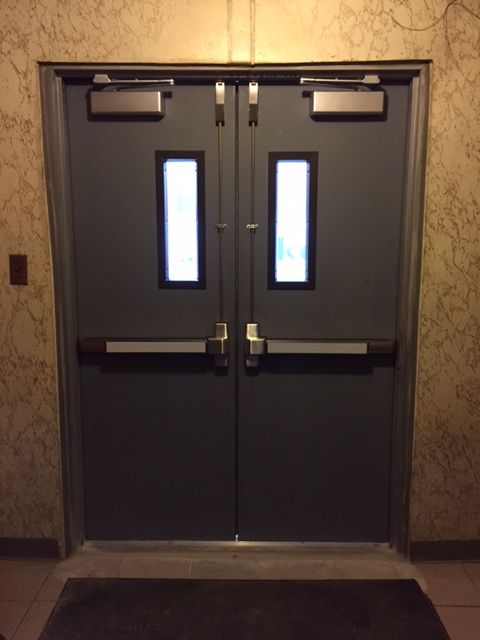
After, from inside: a vertical rod exit device and an overhead closer on each leaf. Both doors now latch top and bottom and release with a push.
Is your church or community building still relying on chains and bolts?
Parker Custom Security replaces entrance doors and exit hardware for houses of worship and public buildings across the Bronx and all of New York City.
How the Door Replacement Was Carried Out
For a church, keeping the entrance usable for the congregation is part of the job. Doors and hardware are ordered and prepared ahead of time, so the old pair is not taken out until everything is on site and ready to hang.
On installation day the crew removed the old leaves and hardware, hung the new doors in the existing opening, and mounted the exit devices, closers, and trim. Before leaving, each leaf is checked the same way: it has to close from fully open without a push, latch at the top and bottom, and release from inside with one motion on the bar. The church ends the day with a secured entrance.
Design & Specifications: Choosing Doors and Hardware for a House of Worship
This section is for pastors, trustees, facilities committees, and property managers scoping similar work. These choices decide how the entrance performs, what it costs, and how long it lasts.
What is a hollow metal door?
A hollow metal door is a commercial steel door built from formed steel face sheets over a reinforced core, hung in a steel frame. Despite the name it is not empty inside. It is the standard door for high-use and code-regulated openings such as stairwells, exits, and public entrances because it resists impact, carries heavy hardware well, and can be manufactured and labeled as a fire-rated assembly.
Panic hardware vs. fire exit hardware
Panic hardware is the push bar that lets someone open a door with one motion, even in a crowd, without knowing how the lock works. Fire exit hardware is panic hardware that is also listed for use on fire-rated doors. The difference matters: a fire-rated door has to use exit hardware listed for that purpose. Most notably, it cannot be "dogged," or held unlatched, because a fire door only works as a barrier when it latches.
Places of worship are assembly spaces under the building code. Egress doors serving an assembly space with an occupant load of 50 or more generally need panic or fire exit hardware. On a pair of doors that needs it, manual flush bolts and surface bolts on the inactive leaf are generally not allowed, because nobody should have to find and release a bolt to get out.
Why vertical rod exit devices on a pair of doors
A vertical rod exit device latches the door into the frame head at the top and into the floor or sill at the bottom, instead of into a strike at the center. On a pair of doors with no center post, that lets each leaf latch and release on its own. Neither door depends on the other, and there is no bolt for anyone to forget. It is the most common way to secure a double entrance without a mullion and still meet egress requirements.
Closers on both leaves
A lock only works when the door is closed. On a fire-rated pair, each leaf has to close and latch on its own to count as a closed fire door. That is why each leaf gets its own closer, sized for the door and set so the door closes fully without slamming.
Vision lites on fire-rated doors
Glass in a fire-rated door has to be listed fire-rated glazing, and the door's rating limits how large the lite can be. Narrow vertical lites, like the ones installed here, give staff and ushers a view of the step outside while staying inside the limits of the rated door.
Keeping fire doors in compliance
Fire-rated door assemblies are expected to be inspected on a regular basis under NFPA 80. Damaged doors, missing closers, and hardware that is not listed for fire doors are the most common failures. See our guide to NYC fire door inspection requirements for what inspectors look for.
The Finished Result
Mount Horeb Church now has an entrance that does what the old one could not. Both leaves close and latch on their own, the building is secured at the top and bottom of each door, and anyone inside can get out with one push, with no chains, bolts, or keys involved.
The street view changed too. Clean gray doors in the original arched brick opening look maintained and cared for, and that is how a neighborhood church wants to look to its neighbors and its members.
- Worn painted steel doors with deteriorated bottom edges
- Daylight visible under the doors
- A closer on one leaf only
- Second leaf held by a manual surface bolt
- A single center lockset on the pair
- New fire-rated hollow metal doors
- A vertical rod exit device on each leaf, latching top and bottom
- A commercial closer on each leaf
- Free exit with one push, and no bolts to forget
- Exterior lever trim and narrow vision lites
Why Churches and Public Buildings Choose Parker Custom Security
Security for places of worship means protecting a building that is meant to stay open to its community. Parker has done this work for congregations across New York City, including panic hardware and high-security locks at St. Clare's Church in Staten Island.
- In business since 2003: more than two decades of commercial doors, entrances, and hardware in New York City.
- Door and hardware as one system: doors, closers, exit devices and commercial door hardware specified to work together.
- Code-aware: fire-rated assemblies and listed exit hardware for assembly occupancies.
- Room to grow: when a congregation is ready, access control for houses of worship and intercoms can be added to the same opening.
- Licensed, bonded, and insured, serving the Bronx, all five boroughs, Westchester County, and Northern New Jersey.
Planning Door Work for a Church or Public Building?
Whether it is one worn entrance or every exit in the building, Parker Custom Security will walk the property and give you a clear scope and estimate at no charge.
Frequently Asked Questions
Who installs fire-rated doors and panic hardware for churches in the Bronx?
Parker Custom Security installs fire-rated doors, panic and fire exit hardware, and commercial door hardware for churches and other houses of worship throughout the Bronx and New York City. The company has been in business since 2003 and is licensed, bonded, and insured. Recent Bronx work includes replacing the main entrance at Mount Horeb Holiness Church of God on Townsend Avenue with fire-rated hollow metal doors, vertical rod exit devices, and a closer on each leaf. Call (212) 491-5627 for a free estimate.
Do churches in New York City need panic bars on their doors?
In most cases, yes. Places of worship are assembly occupancies under the building code, and egress doors serving an assembly space with an occupant load of 50 or more generally require panic hardware or fire exit hardware. That hardware lets people open the door with a single push, even in a crowd. The exact requirement depends on occupant load and on which doors are designated exits, so a site walk-through is the best way to confirm what a particular building needs.
What is the difference between panic hardware and fire exit hardware?
Panic hardware is a push bar or touch bar that opens a door with one motion, without knowledge of how the lock works. Fire exit hardware is panic hardware that is also listed for use on fire-rated doors. A fire-rated door must use listed fire exit hardware. Most notably, that hardware cannot be dogged, or held unlatched, because a fire door only works as a fire barrier when it closes and latches.
Can a church keep its doors locked and still meet fire code?
Yes. Exit devices keep a door locked from the outside while anyone inside can leave with one push on the bar, so the building is secure and still meets egress requirements. What the code does not allow on an exit door is anything that stops people getting out, such as chains, padlocks, or bolts that must be released by hand. Exterior trim, keyed cylinders, or access control handle who can come in from outside.
Why use vertical rod exit devices on a pair of church doors?
A vertical rod exit device latches each door at the top into the frame head and at the bottom into the floor or sill, instead of into a center strike. On a pair of doors with no center post, that lets each leaf latch and release on its own. Neither door depends on the other, and there is no manual bolt for anyone to forget. It is the most common way to secure a double entrance while keeping free exit through both leaves.
What is a hollow metal door?
A hollow metal door is a commercial steel door made from formed steel face sheets over a reinforced core, hung in a steel frame. It is not actually empty inside. Hollow metal doors are the standard for high-use and code-regulated openings such as exits, stairwells, and public entrances because they resist impact, carry heavy commercial hardware well, and can be manufactured and labeled as fire-rated assemblies.
Should old church doors be repaired or replaced?
Repair makes sense when the door itself is sound and only a closer, lock, or hinge has failed. Replacement makes sense when the door has deteriorated, no longer sits true in its frame, or can't accept the exit hardware the building needs. At that point new hardware on an old leaf won't last. Replacing the door and hardware together as one assembly usually costs less over time than repeated repairs to a failing door.